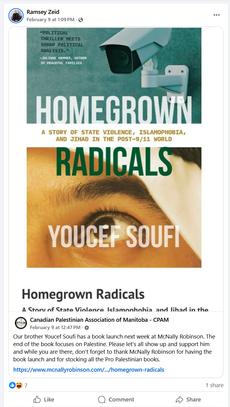
I attended a book launch on Feb 14,2025 at McNally Robinson of a book written by Youcef Soufi , a researcher in Islamophobia with the Centre of Human Rights Research at the University of Manitoba, which is housed at the UM law school. The Centre was established in 2012, a couple of years before the CMHR was opened.
On Feb 9, 2025 the Canadian Palestinian Association of Manitoba (CPAM), whose President is Ramsey Zeid, posted on its facebook page, "Our brother Youcef Soufi has a book launch next week at McNally Robinson. The end of the book focuses on Palestine. Please let's all show up and support him and while you are there, don't forget to thank McNally Robinson for having the book launch and for stocking all the Pro Palestinian books." This was reposted by Ramsey Zeid on his facebook page.
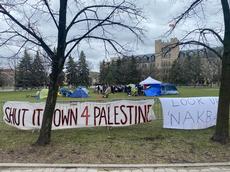
The distinguished professor at the Centre of Human Rights Research is Adele Perry and the manger is Pauline Tennant. They wrote a piece in favour of the UM pro-Palestinian encampment, which the court system eventually found were not legal in Canada.https://chrr.info/blog/reflection/reflections-encampments-and-human-rights/
Soufi, a former Chair of the Canadian Association for the Study of Islam and Muslims, spoke about his book, Homegrown Radicals-A story of State Violence, Islamophobia and Jihad in the Post 9//11 World. Soufi's book (which I have not read) explores the radicalization of three Muslim students from the UM. There were approx.. 30 people at the launch, including several wearing keffiyehs. Soufi said that the ideology of Jihad, for example, “Muslims fighting in Palestine” was not prominent in the 1990’s but is a recent response to the war on terror following 9/11. But that statement strikes me as problematic as relatively newer research by Benny Morris, a prominent Israel historian who has viewed archival material. Morris has concluded that the concept of engaging in religious Jihad amongst the Arabs in the 1948 war was far more prominent than he had originally understood when he first conducted his research into that war.
Soufi’s book does not specifically deal with Zionism but there were references in the book launch to Zionism. Fadi Einnab, also from the U M, was the moderator and he noted that he was of Palestinian descent. He indicated by way of contextualization that Mohammed, one of the radical students put on trial in New York for terrorism is a "a Muslim of Palestinian background," whose dad "is in the UAE like mine." Einnab said "Mohammed was displaced with his family in 1948." And while Einnab did not say this background justifies what he did, he was in my view trying to make the audience sympathize with Mohammed.
Soufi said that his book was written before ,2023 and his book has a short epilogue about , but to deal with Zionism there would need to be a sequel. At no point in reference to at the book launch did Soufi condemn any of the actions of Hamas. He also said that "Anti-Palestinian racism is the issue now." He said people mobilizing in Canada on this issue are called "radicals" and "hateful."
Soufi said that there were lots of Mulims who were "afraid of being interviewed for this book," and there are Muslims who are afraid to be associated with the Muslim community or never to go to a Mosque again.
There was a shout out to McNally Robinson for holding this book launch.
The article referred to above written by Perry and Tennant notes that the Centre for Human Rights Research had a webinar "which explored connections and solidarities with Palestine, and a podcast that included "Winnipeg Centre MP Leah Gazan, Independent Jewish Voices Harold Shuster, University of Ottawa’s Alex Neve, and University of Toronto’s Youcef Soufi on this question." In my view, the selection of panelists gives a sense of the slant of the Centre.
Soufi's Linked In indicates he is a Historian of Islamic thought and researcher into contemporary manifestations of Islamophobia in Canada and the US.
Below is how Sufi's book is described on the McNally Robinson website:
"An unflinching examination of the state violence that created and indelibly tied together the fates of homegrown radical and moderate Muslims in the post-9/11 era
In the shadow of 9/11, Canada saw the emergence of the figure of the homegrown radical Muslim, raising fears and worries about the possibility of an enemy capable of harming and destabilizing the nation. In contrast stood the moderate Muslim, who represented the possibility of unity despite religious and racial differences.
Homegrown Radicals brings these two figures together in uneasy tension, exploring the radicalization of three Muslim students from the Canadian Prairies and tracing North American Muslims' general sense of affective injury over the loss of Muslim life in military campaigns overseas.
Lifting the veil from the experiences of Canadian Muslims during the War on Terror, this book examines the violence that produced a new discourse of jihad, legitimated state surveillance, and sanctioned Islamophobia. It is an effort to understand the forms of empathy and solidarity that North American Muslims had to offer in creating a different and kinder world–if only the state had listened."