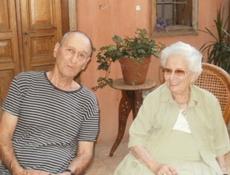
Ruth, who had sat outside in the courtyard area of the house greeting guests, explained to me that the light green cotton dress she was wearing was "from Maskit in the 60's- “they don't make dresses like this by hand anymore," she said, adding that the same dress in white was made for Suzy Eban, the wife of UN Ambassador Abba Eban for when she went abroad.
On the ride through Old Jaffa we passed by the Peres Centre for Peace in the Ajami Arab neighborhood of Jaffa, a strikingly modern building, whose architecture was far different than that of the old style stately Arabic homes. Ruth explained that she disliked the building. "It should have been designed to fit into the neighborhood. It is not at all compatible with the surroundings," she said.
"We are still going to get home," Ruth said, "It's just going to cost us ten more shekel."
He nodded, and said, "O.K. Just this once."
Ruth smiled and said. ‘You see some people here can be nice."
Ruth had told me in an earlier interview that her time at Nahalal, where she met and married Moshe Dayan and began a family, “was very significant.” She arrived in Nahalal in 1934 at age 17 to attend an agricultural college for girls.
“My mother [ who knew Arabic] taught in an Arab kindergarten near Damascus Gate as part of the British education system, and became involved in [setting up] the first Arab-Jewish playground on Mount Zion – it was like a community center,” Ruth recalled. Her parents had “real Arab friends, not just for politics”.
“When people think I am with the Arabs… I was born into it from my parents. I remember religious [Arab] schoolmasters coming over for tea. Moussa Husseini came to my house in Rehavia once a week to give me Arab[ic] lessons at home and he didn’t even take money.
“In order to have a country, we were supposed to work the land and not go to university. I was accepted in the Nahalal [agricultural school]… It was the first college for women… with barns, sheep, chicken and cows. We learned about housekeeping, baking bread, making cheese…," Ruth told me
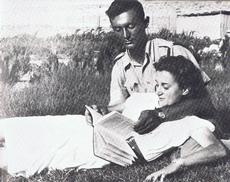
“I met Moshe [Dayan] because all the boys from the farm would come after work to the college to see the girls that came to school." Soon enough, as Moshe’s girlfriend, Ruth moved into the Dayan family dwelling in Nahalal.
“When I went to the Dayan family there was nothing … A table and chairs and a room only a bed could fit into and a wooden shed. The farmers were very poor…Moshe was 18 or 19.” Ruth and Moshe got married for practical reasons.
“Moshe wanted to study very much and my parents liked Moshe and wanted us to go to London like they did. But [we couldn’t] to go to London when I was 18 and he was 20 in those days when we weren’t married.
You couldn’t go as a couple like that and take a flat, so we got married,” Ruth told me
“When Yael was a year old, every time she’d see prisoners working on a road, she’d yell ‘Abba!’ We had a picture of Moshe so she knew what he looked like.” When Moshe returned from prison, it was only a short time before “there was a knock on the door and a top officer [from the Hagana] came to tell him that he’d got to go.” It was World War II. He was to form a unit and cross into Lebanon “to seize the highway bridges” and guard them for Allied Forces to repel any German invasion.
“My life all the time was like James Bond. I never knew what the day would bring,” Ruth told me.
In 1945, “after prison and after losing his eye,” Moshe and Ruth wanted to settle on a farm of their own.
“My father helped us, he bought a farm for us [farmstead 53 on the Nahalal circle],” Ruth explained.
The couple lived at the farm, which Ruth loved, for only three years until the 1948 War of Independence broke out.
“Those three years were fantastic because we worked together… I loved to experiment. We had a lot of fruit, grapes and what not."
In 1948, when Moshe Dayan was transferred to Jerusalem, “we gave our farm to someone to run it.” Years later, when Udi finished his army service, he took over the farm, which was sold many years ago. But there are still Dayan farms on Nahalal, including that of Moshe’s parents, which is still in the family.