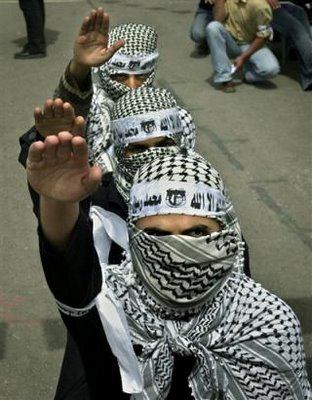
While Western politicians continue to lionize the new-found political freedoms promised by the “Arab Spring” of uprisings from Tunis to Damascus, they will be decidedly less enthusiastic about recent events in Egypt, the first major Arab power to fall to the revolutionaries. In late May, the Jerusalem Post and other Israeli newspapers heralded the birth of a shadowy outfit calling itself “The Egyptian Nazi Party”. The announcement had been picked up via the popular Egyptian daily Al-Masry Al-Youm, which had in turn cannibalized the story from a minor, left-wing online news source called “Al-Badeel”.
The resurgence anywhere in the world of Nazism, the single most malignant and destructive ideology to tarnish the pages of history, rightly set off alarm bells in many quarters. But what does the founding of such a party in Egypt really mean? Is this organization a legitimate threat to Israel, the United States or minority groups in Egyptian society?
The erstwhile leader of this party, Emed Abdel Sattar, certainly talks the talk. Al-Masry Al-Youm quotes him as having a foolproof, streamlined plan for restoring Egypt’s status as a regional superpower, unlike the “marginalized liberal parties, which are like dead bodies”. More worryingly, the original article claims that the Egyptian Nazi Party has spawned two Facebook pages, which are rapidly gaining attention and followers.
However, a comprehensive search of Facebook in both English and Arabic revealed that no such Facebook pages currently exist, having probably been removed in accordance with that social media network’s Terms of Use, which militates against pages that are “hateful, threatening… or incite violence”. Other pages that have been similarly banned, such as those calling for a Third Palestinian Intifada, are usually re-posted by defiant partisans shortly after being taken down. The failure of Egypt’s Nazis to follow suit indicates either that they are poorly organized, or that they don’t really exist.
The Egyptian Nazi Party seems to have been swiftly silenced by Egypt’s military rulers, who can ill-afford the international embarrassment and opprobrium that would naturally result from allowing such an organization to freely operate within their domain. Nevertheless, the deeper societal malaise exemplified by the rise of such a party may soon again raise its ugly head.
But the real question remains: Why would a country such as Egypt, that lacks any significant “Aryan” or Jewish population, spawn a copycat Nazi Party in the aftermath of an ostensibly democratic revolution?
Though it may surprise many, there is in fact a long history of cooperation between certain elements of Arab society and the infamous German Nazis of the Second World War. Hitler and his Italian allies sought to utilize Arab discontent against French and British rule (as well as Zionism) to raise a dangerous fifth column in the Allies’ oil-producing Middle Eastern mandates and puppet regimes. These efforts were spearheaded by Palestinian leader Haj Amin Al-Husseini, who fled to Berlin in November of 1941 after instigating a failed pro-Nazi coup d’état in Iraq in April. That “peaceful Arab uprising” led to the bloody Farhud, a massive pogrom against the Jews of Baghdad during the holiday of Shavuot.
Although similar revolts failed to materialize in Arab lands, sizable webs of Nazi spies and sympathizers remained throughout the War, allegedly including one Anwar Al-Sadat, the Egyptian President who would later sign the historic peace treaty with Israel now threatened by increasing radicalization in the Land of the Pharaohs. Residual Nazi influence continues to live on in Egypt and across the Arab world, most notably in the open and unquestioned publication of anti-Semitic tracts such as The Protocols of the Elders of Zion and Mein Kampf, the ideological blueprints of Nazism.
If Egyptians were simply seeking a political outlet for their anti-Semitism, far more established outfits exist than this ramshackle Egyptian Nazi Party. The long-persecuted Muslim Brotherhood, one of Egypt’s most powerful political forces, is steeped in anti-Semitic tradition. It took part in the aforementioned collaboration with Nazi agents in the Middle East, including the instigation of numerous pogroms against the Jews of Cairo in 1936, 1945 and 1952. In its modern-day manifestation, the Brotherhood maintains a hard-line rejectionist stance toward the State of Israel, and urges the abrogation of its 1979 peace treaty with Egypt.
As a political organization seeking the transformation of the Egyptian state along Islamic lines, the Brotherhood’s affiliated clergy set the tone for its political stances, including its virulent anti-Semitism. Sheikh Yusuf Al-Qaradawi serves as the movement’s senior spiritual guide, as well as one of the leading lights in the Sunni Muslim religious establishment. Unfortunately, he also serves as one of the most prominent anti-Semites in the Arab World. At the height of Operation Cast Lead, Al-Qaradawi told Al-Jazeera that the Holocaust was a well-deserved “divine punishment” against the Jews, and that “Allah willing, the next time will be at the hand of the believers”. To catch this outrageous statement, click here: http://www.memritv.org/clip/en/2005.htm.
Amazingly, some voices in Egypt surpass even the Brotherhood in their anti-Semitic rhetoric and indoctrination. In a 2009 broadcast from Al-Rahma TV, young children are made to memorize and proclaim anti-Semitic slogans. So brazen are this channel’s broadcasters, that one boy is even instructed to recite this litany of hate in English for the world to hear! To watch this pitiful display, click here: http://www.memri.org/clip/en/0/0/0/0/0/814/2066.htm.
So it seems that Egyptian children do not imbibe anti-Semitism with their mother’s milk – rather, they absorb it through mainstream media channels. The sad truth is that Egyptian society is deeply anti-Semitic, even in places beyond the reach of the Muslim Brotherhood. In April 2002, the official newspaper Al-Akhbar, owned by that “great friend of Israel” former President Hosni Mubarak, openly denied the Holocaust and lamented the fact that it “never actually occurred”.
Egypt no longer has any sizable Jewish presence of which to speak, for obvious reasons. But it does have one significant minority group: the Copts, the indigenous Christian inhabitants of Egypt who comprise around 10% of the total population. Discrimination and prejudice against the Copts is somewhat more muted than Egyptian anti-Semitism, although that’s not saying much. Many Copts have fled persecution in their native land and chosen to settle in Europe, the United States and Canada, including a small community in Winnipeg.
Small-scale rioting and pogroms against Copts are sadly common in the rural parts of Egypt, with scores killed every year. But a brazen car-bombing against a church in Alexandria on New Year’s Eve set a shocking new standard for attacks on Egyptian Christians. These outrages have not ceased since the Egyptian Revolution, with a number of Copts murdered in Cairo just last month. Muslim rioters often accuse Copts of seducing and forcibly converting Muslim women, a spurious charge which demonstrates troubling parallels to Nazi propaganda that demonized Jews as the “defilers” of Aryan women.
The Egyptian Nazi Party may be gone, but that’s no reason not to fear the saturation and spread of racial and religious hatreds in Egypt. The former Mubarak government, for all of its faults, at least had an interest in avoiding aggression against Israel and keeping a lid on anti-Coptic unrest in order to maintain political, military and economic aid from its Western allies. There is no guarantee that any new government, especially one led or supported by the Muslim Brotherhood, would show such restraint.
As the massive crowds filled Tahrir Square in February, one could not help but think that a chance for real change was bringing out the best in the Egyptian people. But democracy could yet bring out the worst in Egyptian society, transforming the dream of its idealistic young people into a deadly nightmare.
* Winnipegger Aidan Fishman has completed his first year at the University of Toronto studying International Relations and Middle Eastern Studies.