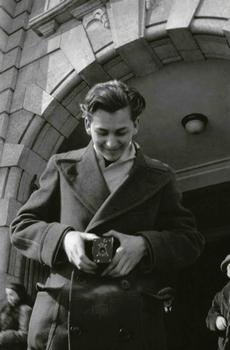
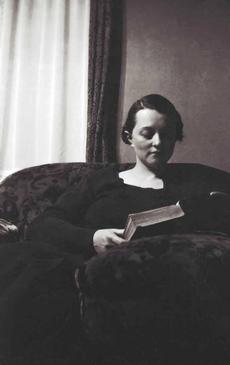
Isadore “Nick” Yudell (1916-1943) was a young Jewish photographer from rural Manitoba who documented the world around him during the Dirty Thirties, and whose work aspires to a modern vision that parallels the art emerging from Europe then. Entering the RAF in 1940, he was sent to Kabrit, Egypt and then Malta to fly missions over Tunisia, and to stop the German supply lines from reaching the Mediterranean. Although he perished in the Western Desert of World War II, his photographs have been brought to life in The Lost Expressionist: Nick Yudell’s Journey in Images, presented at the Jewish Heritage Center of Western Canada, through October 11, 2017. Nick Yudell’s dramatic photographs capture aspects of life, spanning the Jazz Age – when he was 12 and received a camera – and the Great Depression, bridging the 1920’s through 1930’s. His work is a major discovery.
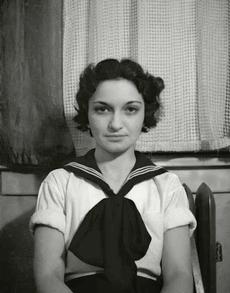
This portrait of his older sister, Mary Ginsburg, taken in the winter of 1932, reveals his patience, a tender eye, and powerful use of light.
Nick was intrigued by air flight, making model planes and shooting the airport at Stevenson Field in Winnipeg. Here he plays with the photograph’s depth of field to create an illusion with his model aircraft. In 1939, the Winnipeg Free Press published a montage of two photographs that he created demonstrating his intent to pursue his work. His notes, and his methods of organization show he used the most current photographic methods.
Nick's work was never lost, rather it was preserved by his cousin, Milton Rabinovitch, who understood it had something of value to offer. He kept Nick's magazines and letters that provide a life in pictures and words — capturing a time previously hidden and now revealed in The Lost Expressionist: Nick Yudell's Journey in Images – a hidden cache, a world seen through the daring eye of an unknown photographer, hosted by the Jewish Heritage Center of Western Canada, Asper Campus, 123 Doncaster Street, Winnipeg, (Sept. 8- Oct. 11, 2017).
The Lost Expressionist was created, restored, and art directed by artist Celia Rabinovitch, Ph.D., M.F.A, who employed new media methods, state of the art printmaking, and archival films in the presentation of a powerful visual story, part of western Canadian history and its adventurous spirit. Alan Yusim, who works in human rights, provided further support and direction for this mjaor project, seen in its first iteration at the JHCWC.