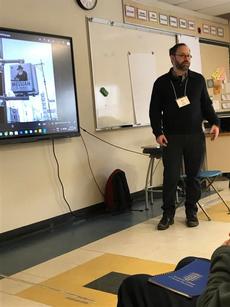
Ezra Glinter, former Winnipegger now living in New York, returned home to deliver a very scholarly, informative, and challenging lecture on the charismatic and controversial seventh, and last, Lubavitcher Rebbe, Rabbi Menachem Mendel Schneerson (1902 – 1994), at the 15th annual Limmud Winnipeg Festival of Life and Learning held at the Asper Jewish Community Campus on March 23, 2025.
Glinter is an author, translator, biographer, and senior writer and editor at the Yiddish Book Center. He has published two books. His Have I Got a Story for You (WW Norton, 2016) is a collection of stories he gleaned from the archives of the Forward, America’s foremost Yiddish newspaper, on immigrant life in New York. His recently released biography Menachem Mendel Schneerson: Becoming the Messiah (Yale University Press, 2024) is the culmination of years of deep research into the man and the movement he led.
What Glinter described as his “fascination with the theology” of messianic Judaism, its “beautiful structure of human thought,” was clearly evident and eloquently conveyed in his presentation.
His detailed historical survey of the ideas and philosophy of medieval mystical Kabbalah, the development of Hasidism in the 18th century, and the emergence of the Chabad-Lubavitch movement, though dense and difficult, gave context to the story of the controversy surrounding Menachem Mendel Schneerson, which concerns his messianic passion and the question of whether he believed he himself was the messiah.
It is the philosophy of Chabad-Lubavitch that humans have a part to play in hastening the arrival of the Moshiah and in the redemption of the messianic age by acts of goodness and kindness. Through good deeds, every person can actualize the era of cosmic perfection and universal awareness of God. Menachem Mendel Schneerson constantly spoke of the imminence of the messianic age and humanity’s responsibility in bringing it about. His injunction to his followers was: "You are Divinely gifted with enormous strength and energy — actualize it!"
We learned that Menachem Mendel Schneerson was born in Nikolaev, Russia in 1902, married the daughter of the 6th Rebbe Yosef Yitzchak Schneerson, Rebbetzin Chaya Mushka, in 1928, and escaped the Holocaust with her from Paris in 1941, settling in New York City. With the passing of his father-in-law in 1950, Menachem Mendel Schneerson was chosen as his successor, becoming the 7th Rebbe and leader of the Lubavitch movement.
In a talk the Rebbe gave on his father-in-law’s first yahrzeit, entitled, “I Have Come to My Garden,” he drew on Midrash and aligned it with Chabad, saying just as Moses was the 7th generation from Abraham—the first to bring the Shekhinah (Divine essence) back to earth after it withdrew following the sin of Adam and Eve, so were his followers the 7th generation of Chabad tasked with bringing the Shekhinah to earth.
What followed was a discussion of what it means to bring the Shekhina to earth, what happens at the end of days when the Messiah comes. Glinter explained Maimonides’ version and then showed how 16th century Isaac Luria’s Kabbalistic mysticism gave new meaning to messianism as did the mid 18th century Hassidic movement of the Baal Shem Tov. Glinter described Luria’s concept of tzimtzum, according to which God contracted in order to make room for his creation in the universe, directing his divine light into vessels that burst, bringing imperfection into the world and making it humanity’s purpose to perform tikkun (“to repair”) the world by fulfilling the commandments.
In Hasidic theology tzimtzum is “metaphorical retraction”: “God did not withdraw but concealed himself so that he can be revealed, which “adds another new meaning to messianism.” Lurianic messianism is about restoration; Hasidism is about ultimate revelation in the world.” God is revealed totally, and yet the world continues to exist in the messianic age. “God is perceptual in the world physically.”
Which took Glinter back to Menachem Mendel Schneerson’s talk. By bringing the Shekhinah back to earth, this is the revelation of God in the messianic age. The Rebbe relentlessly preached “the 7th generation meant the messianic age was imminently coming, and this aroused a lot of controversy.” Questions arose such as, “If the Messiah is coming, do laws change?”
And his followers started to believe the Rebbe was the Messiah. In fact, there is a banner in Crowne Heights in Brooklyn, New York announcing, “The Messiah is here.”
Glinter sees the Rebbe’s followers’ belief as they await the “thing that has to happen,” as “a way to make it happen. Identifying the Messiah is a way to make it happen.”
However, “it is still an open question.” The Rebbe did not insist he was the Messiah but that his father-in-law was. But he himself did believe that each successor encapsulated his predecessor’s essence, so in thus speaking about his father-in-law, he was speaking about himself. And in talks he gave between 1989 and 1992, he began to say suggestive things about the Messiah having arrived.
Thirty-one years later, the controversy persists, and Chabad is carrying out its mission without a successor to the 7th Rebbe.