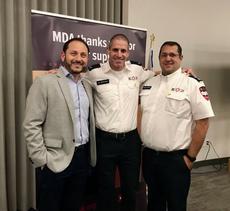
The Canadian Magen David Adom (CMDA), together with Congregation Etz Chayim, presented “The Spirit of MDA and the Heroes of October 7” on May 8 at Congregation Etz Chayim. About ninety people were in attendance. Uri Shacham, MDA Deputy Director and Chief of Staff; Raphael Herbst, MDA Deputy Director, Fundraising and International Relations; Sidney Benizri, MDA National Executive Director; and Sharon Fraiman, MDA Western Region Director, Major Gifts, made guest appearances. Firsthand accounts of the heroic work of MDA on a daily basis in Israel, on the dark day of October 7, 2023, and during the current Gaza conflict testified to the invaluable work of MDA in fulfilling its mission of “protecting, saving, and giving life,” and above all, “giving hope.”
Rabbi Kliel Rose, spiritual leader of Congregation Etz Chayim, welcomed the speakers and audience, recounting a personal story about MDA. He related how he has known many young people who have done internships in Israel with MDA which were instrumental in defining their life path. His close friend and first cousin, Dr. Jeremy Rose, is now Medical Director of Emergency Care at New York-Presbyterian Hospital, thanks to the experience he gained as an intern with MDA.
Tracy Kasner, Cantor of Congregation Etz Chayim, gave blessings and words of hope and recited the Prayer for the Redemption of the Hostages.
Sharon Fraiman praised both the valiant efforts of MDA, calling paramedics Uri and Raphael “our heroes,” as well as the inestimable contribution of the Friends of CMDA, without whose support MDA would not be able to offer the lifesaving it provides, being a non-governmental organization it depends solely on donations. She thanked Uri Shacham and Raphael Herbst, who traveled from Israel for the event, and Sidney Benizri, who traveled from Montreal.
Keynote speaker Uri Shacham’s energetic and extraordinarily uplifting presentation must surely have enlisted the entire audience’s support of the noble efforts of MDA. Hopefully, many new donations will soon follow.
Uri gave a heart-felt and heart-warming thank you to the audience “as an Israeli, not as a representative of MDA,” explaining “what we’ve needed most is to know that someone outside Israel cares about us.”
He thanked us for coming, especially after the Jet’s disappointing loss the night before. And he promised us the “professionalism, dedication, and unwavering support for the Jets” assure a win next time. “The same thing applies to MDA”: its professionalism, devotion, and the support it has will also ensure its ongoing success in saving lives.
A short video described the lifesaving operation of MDA, served by EMT’s, paramedics, ambulance teams, and the 600 bikers who patrol the country assisted by the helicopters, rescue boats, and bullet-proof ambulances that arrive in less than 5 minutes. Established in 1930, it served to transport patients in Tel Aviv in the day and trained Haganah forces at night, becoming the basis for the formation of the medical corps of the IDF.
Uri told the story of a young boy in Klahim, Negev on Rosh Hashanah Eve, who had three fingers amputated. On receiving the call, alerting the microsurgery team at the Sheba Hospital in Tel Aviv, and realizing the two-hour drive was impossible, MDA dispatched a helicopter to transfer the boy, and two and a half fingers were reconnected successfully. “This story encapsulates all MDA does,” according to Uri: protecting life, saving life, and giving life, and bringing hope.
MDA protects life by constantly preparing for anything that might happen, anticipating and providing what is needed through its 32,000 volunteers, 3200 paid staff, and 15,000 on-call first responders. However, being prepared for the 6000 Hamas, Palestinian Islamic Jihad, and other terrorist groups, followed by a third wave of Gazan civilians, with no forewarning was difficult. Still, MDA was able to respond thanks to their preparedness.
Saving life is also a challenge but one constantly met by MDA. Every 14 seconds a call is received; in one second, location, which team, and what priority are determined. All emergency services are alerted. Every 36 seconds, a team is deployed. In order to act quickly, a variety of rescue vehicles are used; “nothing will prevent us from getting to the patient fast.”
Giving life is the central goal of MDA, and it does this especially through its Blood Bank, “the beating heart of Israel’s health care system.” Operating 24/7, it “assures life for all.” It can provide blood before the person even arrives at the hospital. It is the only blood bank that is completely underground to secure the blood service. This is a part of their preparedness mandate. In the last 18 months, since October 7, they have been working underground as missiles have actually reached Tel Aviv, not thought possible when MDA began. This is “something we are very proud of.”
Everything MDA prepared for allowed them to respond to October 7. Though a meeting on October 5 with the police and army did not indicate an obvious or unusual threat, MDA decided to have a high-level alert as it was Sukkot. MDA members were told to take their ambulances home in case of an emergency. Therefore, they had 120 ambulances above the number of a regular shift. Two other decisions saved 100’s of lives. The night shifts at MDA stations were told to stay, thereby doubling staff. The entire fleet of 1400 ambulances was made active (usually only a third are). At 6:46, MDA learned terrorists had invaded on paragliders, and at 6:55, that a shooting incident had occurred in Sderot. At 7:01 a.m., MDA teams arrived, and ambulance 1376 was immediately attacked with AK-47’s.
The third decision was to send bullet-proof ambulances to the border of Gaza from Judea and Samaria.
Where uniforms before October 7 were seen as protective vests, now they offered no protection; they were being shot at deliberately. Maps found on dead terrorists in Sderot showed MDA centres were marked as key targets to attack with the aim of controlling Sderot. They knew MDA would come to help.
Uri commented, Jews “may not believe in miracles, but we rely on them.” And on October 7, one miracle did happen as the gate to the MDA centre was closed, though it is usually open in such an emergency situation; this saved the entire MDA team.
As the first thing the terrorists did was shoot ambulances, “we had to change our thinking”; unable to take the wounded to hospitals outside Sderot as the roads had become “killing roads” controlled by Hamas, they treated people in special centres set up in the kibbutzim and in pop-up care centres on roads. There was a primary care station for treating the 100’s fleeing the Nova festival site, other kibbutzim, and military stations. Field units were also set up in MDA stations, which, because of their preparedness, had boxes of medical kits that enabled them to treat many victims.
Uri acknowledged six key MDA members who were lost on October 7 and showed photos of them. One of the fallen was a young paramedic instructor who stayed in Kibbutz Be’eri to treat victims until ammunition ran out, and all were killed. “The tragedy of humanitarians dying is unbearable. We have many projects on their behalf.”
Another heart-breaking story Uri told was of a nine-year-old boy Michael and his six-year-old sister who saw their mother and father killed in Kfar Aza. They were in their shelter not knowing what to do. Uri played the recorded call between an MDA dispatcher and Michael as he tried to reassure the terrified Michael, telling him to hide with his sister in the closet under clothes, keeping his phone close and muted, promising help will come, giving him life-saving hope. As Uri noted the dispatcher bravely followed MDA’s duty: “if you can’t help, call back and speak to the person’s heart, provide hope.”
Michael and his sister were rescued. And his other sister, whom Michael thought had also died, was actually abducted to Gaza and was released after 32 days in captivity. They are now living together with their aunt.
Thirty-eight MDA members have been lost since October 7. When they died, Uri said, “they commanded us to keep walking the path, responding to war, transporting soldiers, and working in communities.” The communities that were prepared survived; therefore, MDA is training groups in the kibbutzim to be response teams, providing them with necessary tools, and building resilience.
Uri’s final impassioned plea surely moved all present: “If you want to know and experience Israel, support MDA. We could not have done what we did without your assistance. We are doing this together. You are here with me. Words cannot express how grateful we are. We will prevail. Am Israel Chai.”